
What You Need To Know About Algonquin Portages & Backcountry Camping

As someone who has spent the past four summers embarking on numerous backcountry camping trips in Algonquin Park, I have gained a wealth of insights and expertise from these experiences.
I have had the privilege of camping alongside family and friends who have been backcountry enthusiasts for over 15 years, evolving into experts in the field.
I appreciate that embarking on an Algonquin backcountry camping trip can be nerve-wracking, especially for first-time campers or those returning after a hiatus. Therefore, this comprehensive guide aims to help you confidently plan and execute a successful Algonquin portage and camping trip.

An Algonquin backcountry experience requires careful planning and adherence to safety measures. Understanding wildlife safety is paramount, given the presence of bears and moose in the park.
As you read through this guide, you will discover tips on selecting the right camping route, reserving permits, campsite etiquette and the art of portaging.
Whether you are a seasoned backcountry camper or embarking on this adventure for the first time, this article will equip you with the knowledge needed to navigate Algonquin Provincial Park.
What is Backcountry Camping?

Backcountry camping is a wilderness adventure, unlike car camping or glamping.
This camping style involves being self-sufficient and cooking on a fire or portable camping stove, far from civilization, without any amenities like flushing toilets or cell service.
When backcountry camping, you will reach your camping site by hiking, canoeing, or another outdoor method; therefore, you will be away from any developed areas.
You must be able to carry all your belongings either on your back or within your canoe.
You must be aware of wildlife safety in places such as Algonquin Park in Ontario because there is a population of bears and moose. You will discover some of these practices later in the article.
What is Portaging?

Portaging is a term used in backcountry camping and canoeing, referring to the process of carrying a canoe overland between bodies of water when encountering an obstacle, such as a waterfall or rapids.
During a portage, campers take their boats out of the water, lift them onto their shoulders, and carry them over the land to reach the next navigable waterway.
Algonquin portages can vary in length, from a few hundred metres to over a kilometre, and can be physically demanding, especially with heavy gear and equipment.
Therefore, you must be able to carry all items between you and your group.
Algonquin Park Portage Information

Before setting off for your portage trip in Algonquin, you must have a reserved camping spot or a day-park permit, ensuring entry to Algonquin Park.
You can go portaging as a daytime activity on Algonquin camping trips to explore the area around your campsite.
Alternatively, you may prefer to portage to a new location each day, booking different campsites for each night.
While on the water, you can find out where the portage landing spots are due to the Algonquin portage signs.
These square yellow signs on trees with a person carrying a canoe signify the start (or end) point. The signs usually describe the length of the portage and which lake the portage starts and ends at.
You can also find the length and location of the portages on an Algonquin Provincial Park map.
A line on the map will indicate the portage that helps you to cross from one lake to another. In some maps, a black line on the map means a maintained portage route, whereas a red line is an unmaintained trail. Other maps may show lines in only one colour.
The distance of the portage is indicated by a figure in a red box, for example, 450 metres. Or, it is shown by the letter P and a number, for example, P 450.
When preparing for your canoe trip, you should pack in a manner that makes it easy to carry.
Use techniques such as clipping items onto large backpacks or securing them with bungee cords to ensure the gear is both manageable and secure during the portage.
Where is Algonquin Provincial Park?
Algonquin Provincial Park is in Ontario, Canada and is approximately 3 hours north of Toronto.
Depending on the specific campsite or access point within the park, you may need to drive an additional 45 minutes from the West Gate to reach your destination. Otherwise, you can access it from the East Gate if coming from the Ottawa region.
When To Go Backcountry Camping Algonquin Park?

When planning a canoe camping trip to Algonquin Park, the timing of your visit can bring a very different result.
As soon as the ice clears from the lakes, typically in early spring, you can start considering a backcountry camping adventure. The canoe camping season usually runs from May to October.
Even so, consider several important factors when selecting the best date for your backcountry canoe trip.
If you prefer to avoid crowds, it is advisable to avoid the weekends, particularly the long weekend in early August, plus the first two weeks of August when the park tends to be busier. The days are warm and the nights offer a refreshing coolness in August, making it a popular time for visitors.
To escape the notorious black flies, avoid late May to late June. In addition, late July usually brings the hottest summer temperatures, so if you prefer milder weather, it is best to go camping in spring or late summer.
If witnessing the stunning fall colours is a priority, late September could be an ideal time to visit Algonquin Park. Even though the days and nights may be colder, the vibrant foliage makes it a breathtaking experience.
Be aware that June is the worst month for mosquitos, but they will still be present in July and August, particularly in the evening. Consequently, wear long sleeves and use insect repellent to protect yourself from mosquito bites. Light-coloured clothing, such as white, tan or khaki, is better than dark colours to avoid attracting mosquitos, but this can be unpractical while camping.
For a more pleasant experience with favourable weather and fewer people, consider planning your canoe camping trip after the Labour Day weekend (the first weekend in September).
Trip Planning: Canoe Camping in Algonquin Park

When choosing a route for your backcountry camping and portaging trip, consider your experience level and preferences.
Decide whether you want to do an Algonquin portage trip that involves moving campsites every night or opt for a more relaxed experience by canoeing or portaging to your first campsite and staying there for a few nights.
Beginner backcountry campers may prefer a two-night camping trip to whet their appetite. On the other hand, more experienced campers may want three nights or more to fully unwind and enjoy the outdoors.
Remember that portages over 1000 m can be arduous, and you should avoid having more than one long portage in a day, especially if you have heavy food barrels to carry.
Ideally, you should be able to carry all your belongings in one go between your whole group. For example, one person carries a backpack while another holds the canoe. However, it is extremely helpful to have members of your group who can carry the canoe on their shoulders and a backpack on their backs. Particularly, if you have numerous backpacks.
If you cannot carry all your belongings in one go, be prepared for extra walking. You will need to walk to the end of the portage with part of your gear, return to the starting point without any items, and then walk along the trail a third time to retrieve the remaining items.
On your return to the start point, you could offer to carry some lighter items for campers going in the opposite direction if you are empty-handed.
Where to Camp in Algonquin Park?
Numerous lakes serve as access points in Algonquin Park, meaning you will start your camping trip there.
It is possible to end your Algonquin portage at another access point, but you will need to arrange logistics for getting back to your car.
Algonquin Backcountry Access Points
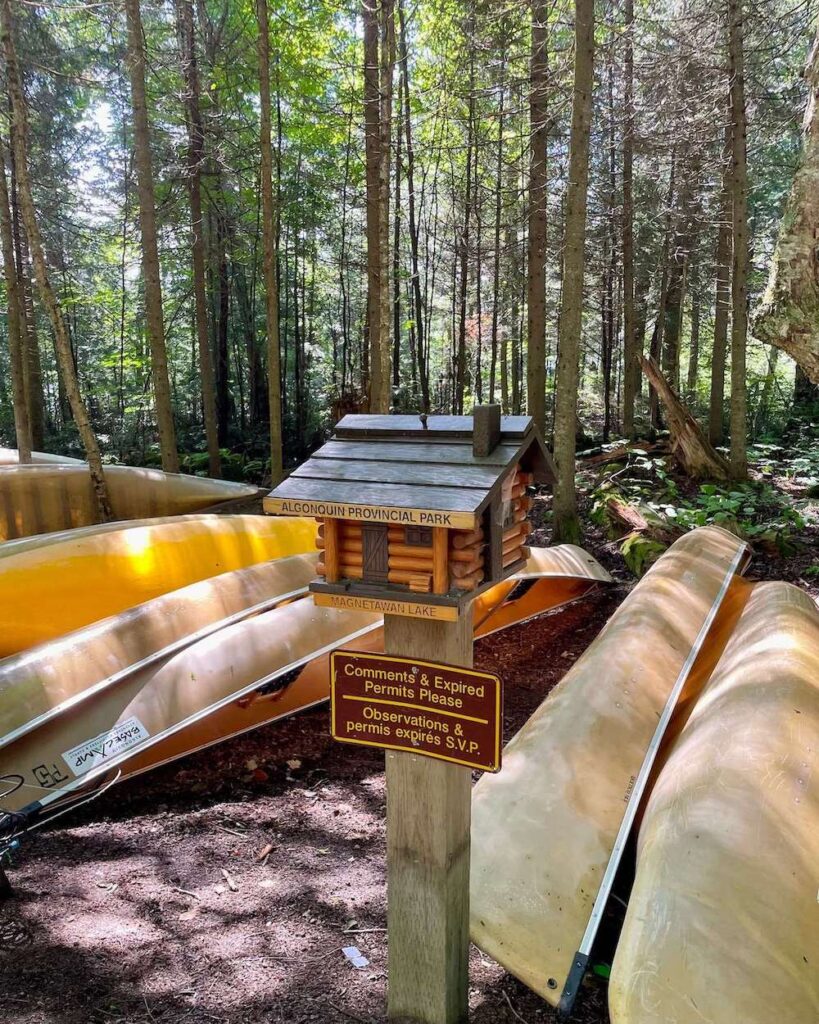
The Algonquin Park website has a list of access points.
The two access points that I have visited and have experience with are:
You can read all about my experiences at each of these access points at the corresponding links above.
If you need advice on selecting a canoeing route, you can call an Algonquin canoe rental shop (where you will later reserve your canoe) and they will give you suggestions.
Ensure you have a canoe route map to refer to.
Algonquin Park Campsites

When considering backcountry camping in Algonquin Park, note that you cannot reserve a specific campsite in advance.
Campsites are self-assigned on a first-come, first-served basis when you arrive at the lake.
Upon arrival at your pre-reserved lake, you are allowed to choose any available campsite.
Timing is crucial; arriving too early might mean the previous campers have not left. While arriving too late could result in the best spots already being taken.
This reservation style differs from yurt camping in Tobermory, where you can reserve a specific tent spot in advance. Or when you book Algonquin backcountry cabins, such as the ranger cabin on rain lake, in which you are allocated the exact log cabin booked.
Algonquin Canoe Routes

To help you plan your Algonquin portage trip, you can refer to the digital map on Algonquin Park’s website.
It is also possible to purchase a hard copy of an Algonquin portage map on the website too.
It is recommended to have a printed version of a map of Algonquin Park to help you while you are in the park. Cell service will be limited and there are limited options for charging your phone when backcountry camping.
Here are some sample Algonquin portage routes that you may wish to consider.
Single-Site Backcountry Camping with a Portage Day Trip
- Rock Lake to Pen Lake (and return the same way) – P375
- Rock Lake to Galeairy Lake (and return the same way) – P100
Easy Multi-Campsite Portage Trip
- Ralph Bice Lake, Little Trout Lake, Queer Lake (Magnetawan Lake Access Point)
Experienced Multi-Campsite Portage Trip
- Little Trout Lake, Moccasin Lake, Casey Lake (Magnetawan Lake Access Point)
Read my article on Magnetawan Lake Access for more details on the portage loops starting at this location. You will also find information about specific campsites in Algonquin Park on these loops.
How To Choose a Campsite?
There are numerous factors to consider when selecting a campsite in Algonquin Park. The best Algonquin campgrounds incorporate the majority of these characteristics.
Weather
Depending on the weather forecast, if rain is expected, opt for a campsite with ample tree coverage.
During mosquito or fly season, an exposed site with a breeze can keep these insects at bay. On the other hand, when camping in cooler temperatures, you should choose a spot that is sheltered from the wind.
Facilities

Before settling in, check the site for flat areas that accommodate the entire group’s tents and consider if the ground has a flat surface for sleeping on.
Check for sufficient logs that can be used for seating and if there are grills on the fire pit for cooking. Some campsites even have additional surfaces like built-in shelves across trees that make good meal prep stations.
It is also worth assessing the condition of the Thunder Box (toilet), as a less full box tends to be slightly more pleasant. Some campsites have newer toilet facilities – you can tell by the condition of the wood.
Privacy
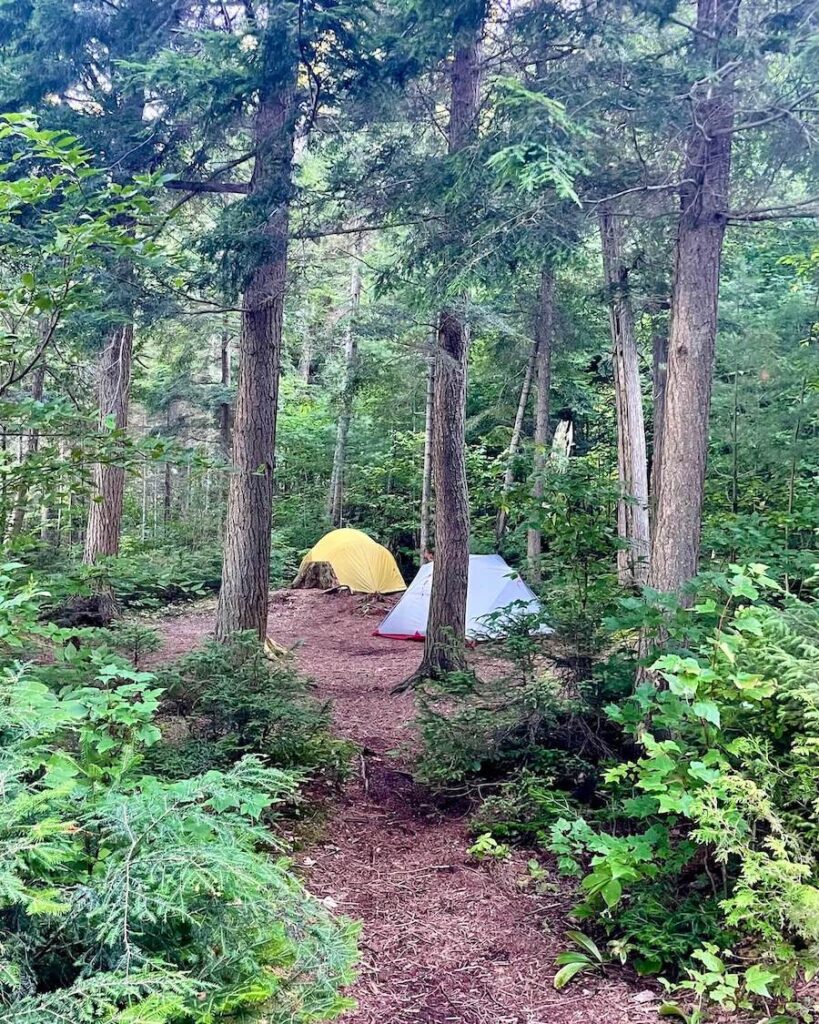
An important consideration for many is how private your campsite feels.
There may be a few other groups camping on the lake, but if you can hear noise from a nearby campsite, it may ruin the appeal of being in the backcountry. Therefore, you may wish to select a more private campsite further away from other people.
We could envision this happening on Casey Lake at the Magnetawan Lake access point because there are three campsites on the lake. Two campsites are close by, and one is slightly more isolated.
Speaking of privacy, you may also want to check that the Thunder Box is far away enough from the communal area that you do not feel too exposed, but near enough to camp to not feel uneasy at being vulnerable.
Water-Edge

Look for a campsite with a convenient shoreline for storing your canoe and easy access to the water.
Large flat boulders along the water’s edge are beneficial for swimming, sunbathing, and reading a book. Ideally, the water is relatively clear and without gunk, and does not have lily pads.
A campsite with a good view across the lake or a sunset view is a bonus.
How To Prepare to Portage Algonquin Park?

There is a range of items that must be packed and prepared before a portaging trip to Algonquin Park, including camping gear, canoes, food, clothing, and park permits.
What Gear to Pack for Algonquin Backcountry Camping?
You cannot go to Algonquin Park backcountry camping without the following products. Make sure you own them or can borrow them from a friend.
It is also possible to rent some of this equipment from canoe outfitters.

Sleeping & Shelter:
- Tent
- Trekking Backpack
- Rope
- Tarp
- Sleeping Mat
- Sleeping Bag
- Pillow
Food and Water:
- Water Filtration System
- Water Purification Tablets
- Camp Stove
- Kitchen Cookware
- Knife
- Food Barrel/Bear Proof-Bag
- Water Bottle
- Empty Plastic Bag
- Espresso Maker
- Collapsible Sink
- Biodegradable Soap
- Lighter/Waterproof Matches
Safety Items:
- Personal Flotation Device (PFD)
- Map
- First Aid Kit
- Sources of Light (Flashlight/Headtorch, Lantern)
- Hatchet and/or Sledgehammer
- Compass
- Firewood (if allowed)
Find a more detailed version of the backcountry camping packing list here.
Canoe Rental Algonquin

On Algonquin backcountry camping and portaging trips, you should rent a canoe and paddles to get to your campsite. Book this sooner rather than later in case all the supply has gone.
There are several sizes of canoes to rent, based on size (for cargo), weight and paddlers.
Kayak rentals are also available but note that these vessels may be able to carry less equipment than a canoe.
Some lake access points have outfitters on the lake, so you can pick up your rented canoe directly. Whereas, other Algonquin outfitters offer delivery services.
You can choose to have your canoe delivered to your access point (sometimes for a fee). I would suggest that you arrange this for convenience purposes. Otherwise, you must carry the canoe on the top of your roof.
The companies that I would recommend renting your equipment from are:
- Opeongo Outfitters
- Algonquin Outfitters
- Canoe Algonquin
Look into each of these rental companies because one may be more suitable for you than another based on the location of your chosen access point.
Clothing

The type of clothes that you should be packing are older clothes that you will not be upset if they get damaged. Choose comfortable attire that allows you to be active and move freely.
Given the potential for chilly nights, packing leggings and warm socks for your camping wardrobe is recommended.
Even if rain is not in the forecast, it is wise to bring a raincoat because the weather conditions can quickly change, and you will not have access to any weather reports online.
Remember to choose lightweight and quick-drying fabrics for clothing and consider layering for varying weather conditions.
Pack enough changes of clothes for the duration of your trip while also keeping in mind the activities you will be engaging in and the potential for clothes to get wet or dirty.
Keens, Tevas, EVA Birkenstocks, and Crocs make excellent campsite shoes. These comfortable and waterproof footwear options will give your feet a break around the campsite and are convenient for water-side activities.
- Bathing Suit
- T-Shirts (sweat-resistant fabric)
- Shorts (quick-drying)
- Warm Sweater or Fleece
- Long Pants (not jeans)
- Leggings or Long Johns
- Daytime Socks (activewear, ankle coverage)
- Warm Socks (for evenings)
- Underwear
- Rain Jacket
- Hat (wide-brimmed or baseball cap)
- Sunglasses (with UV protection)
- Old Running Shoes or Hiking Shoes (durable, can get wet)
- Campsite Shoes (sandals or sturdy shoes)
- Belt Bag (fanny pack for essentials)
- Backpack (for day trips without main camping gear)
Food

Your food during an Algonquin backcountry camping adventure must be well-considered.
On your first day of camping, you chould eat fresh or slowly defrosting items since you will not have access to a fridge. Subsequent nights require non-perishable or dry foods stored at room temperature.
You need to formulate the entire camping meal plan at home because you will not be able to leave the backcountry to find a grocery store.
Remember, your camp stove will be your main cooking tool, so select foods that can be easily prepared with the equipment you have.
While cooking over a campfire is a possibility, it is not a reliable method due to potential fire bans or adverse weather conditions.
Discover more about planning your camping meals in this article.
If arranging meals becomes a hassle, you also have the option of purchasing a meal kit through food outfitting services available in Algonquin Park. Trip packages are especially convenient if you are travelling from outside Ontario or have a busy schedule.
Car Rental
If you do not have access to a car or you are visiting Ontario as a tourist, you will need to rent a car. It is difficult to get to Algonquin Park without a car.
Rental cars can easily run out of inventory, so if this is something you will need, get it booked as soon as you can. Prices are usually more affordable for car rentals in advance.
How to Get Algonquin Park Permits?

Reservations and permits are essential for backcountry camping in Algonquin Park.
To secure your spot, aim to reserve your backcountry campsites well in advance – ideally, as soon as the bookings open, which is usually five months in advance.
Availability will be limited at peak times, like holidays, weekends, July, August, or the September Labour Day weekend.
For quieter Algonquin camping trips, consider mid-week stays and avoid long weekends that attract crowds.
You must pick up your permit from the park office on your way to Algonquin Provincial Park at the nearest office to your access point. Always have the permit on you, as rangers might need to confirm your permission to be on the lake.
Lastly, if you plan to fish while in Algonquin’s backcountry, remember to obtain a fishing license.
Step-by-Step Guide for Securing Algonquin Permits
- Begin by navigating to the official Ontario Parks reservations website.
- Locate the Backcountry tab situated at the top of the page.
- Opt for the “backcountry paddling” option from the available choices.
- Choose Algonquin Park as your destination and specify the lake access point along with your intended arrival date.
- Use the map to designate your preferred lake for camping (e.g., Rock Lake).
- Click on “Add to Stay” found on the right-hand side of the page.
- If your plan involves multiple nights across various lakes, you can easily select additional lakes for each night.
- Your booking details will be displayed at the top of the page. Click on “reserve” to finalize and complete your booking process.
Algonquin Campsite Set-Up Tips

Once at your campsite, quickly set up all your equipment in case of rain or before it gets dark and becomes more challenging.
Find a spot to put your tent up that avoids low-lying areas prone to flooding and is far from the firepit and any food.
Next, you should collect some water from the deepest part of the lake and start to purify it so it is ready when you need to fill up your water bottle or start cooking dinner.
Finally, make sure you have located a tree with a sturdy branch where you can hang your food barrel. Otherwise, find a spot 30 metres from your campsite to put your bear-proof bag or canister.
You should also signal your presence at a campsite by hanging a towel from a tree or placing your canoe in view. This will prevent other campers from paddling over when looking for a site.
Rules and Regulations for Portaging in Algonquin Park
When you are portaging in Algonquin Park, it is important to be aware of the rules and regulations that help maintain the park for future visitors.
You should do your part to help keep the park clean. Leave your campsite in the same condition or better than you found it. Therefore, do not bring glass or cans with you.
Additionally, do not burn foreign objects in the fire instead of packing them and carrying them out of the park. There have been numerous occasions when we have arrived at a campsite with crushed and semi-burnt cans of beer in the firepit.
Follow the “Leave No Trace” principle, which means taking everything you brought back home, including any trash or items that might have been damaged during your journey.
Safety Tips for Algonquin Portages

You should have at least one member of your group who is experienced in backcountry camping and canoeing.
All members of your group should always have their life jackets on while canoeing. When portaging, you can clip the life jackets to the inside of the canoe to make it easier to carry. It can also help with making some padding for your shoulders.
Make sure all members of your group can swim and do not take your boat onto the water when there is a storm.
Be considerate of other groups portaging. If you arrive at a portage start point at the same time as another group, make sure there is space for them to offload by moving your stuff to the side. Alternatively, be quick to move out of their way.
If you are not carrying a canoe but encounter someone who is, give them ample space to pass through. The person carrying the canoe has priority.
You should practice with your equipment, for example, putting up your tent and using the camping stove at home before your portaging trip.
It is essential to master other basic camping tasks, such as fire lighting and water filtration. Multiple members of your group should be proficient in these skills.
Wildlife Safety Regulations

There are several best practices to keep safe from wildlife while backcountry camping.
For example, you should refrain from eating in your tent and avoid bringing toiletries inside. You do not want to entice animals such as bears or moose into your sleeping area with these smells.
Keep a clean campsite to steer off any unwanted wildlife. Chipmunks may come to your campsite looking for food droppings. They can become a pest, so you should clear up any mess into waste bags and pack them away into the lockable food barrel.
Watch videos or read guides on how to hang a food barrel from a tree if you do not know how to.
If this is the first time you are going backcountry camping in Ontario (or North America for that matter), you would be wise to read up on some animal safety tips. There is a genuine chance of a bear encounter in Ontario, so being prepared is important.
Know what to do if you encounter a bear, and learn preventative measures, such as maintaining a clean campsite and following food preparation guidelines.
I recommend reading websites such as Ontario.ca and North Frontenac.


